iRacing Endurance Mindset: Consistency and Teamwork
Prepare for iRacing endurance racing with consistent stints, clear communication, sensible traffic decisions and a shared plan for the whole team.
Success is not about one driver’s heroics. It is the outcome of a cohesive team executing a shared strategy with precision. This philosophy is the foundation for any meaningful iRacing endurance advice and is central to our mission at Endurotech Racing. Before you can improve your performance, you must first adopt this mindset. The following sim racing tips are built upon this very principle.
Ten habits for more consistent endurance racing
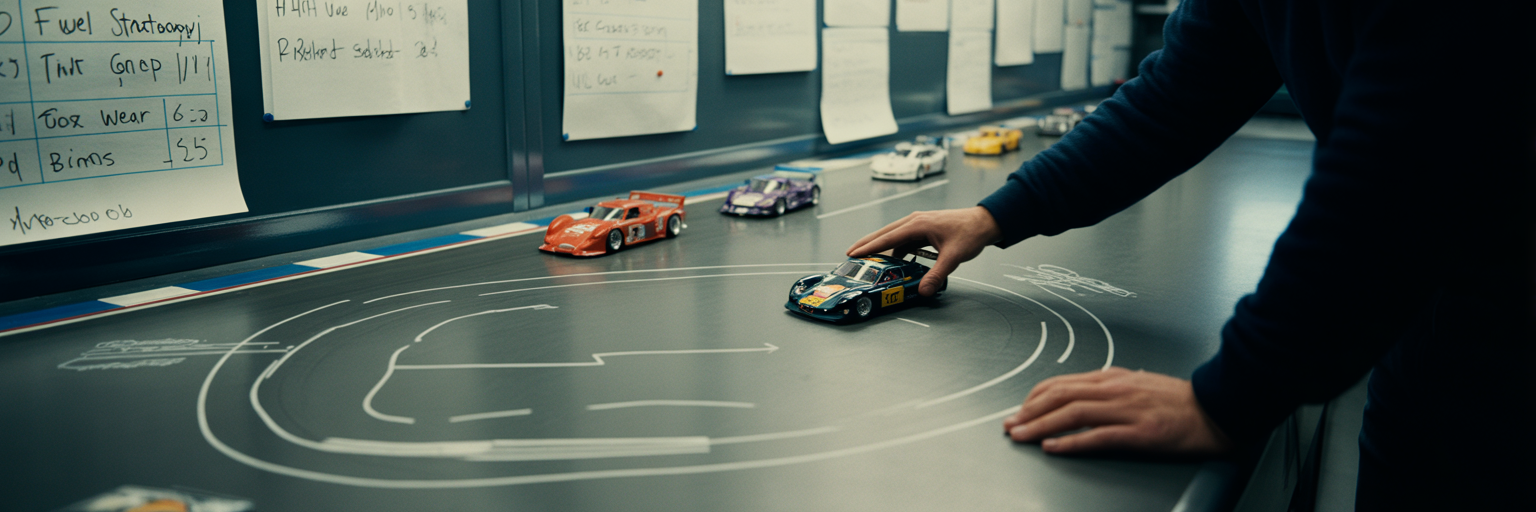
Improving your endurance racing performance requires a systematic approach that goes far beyond just putting in more laps. Here are ten strategies our team uses to compete at a high level in iRacing’s toughest events.
- Prioritize Consistency Over Raw Speed
We’ve all seen it: the driver who sets a purple lap and then bins it in the wall two laps later. In endurance, a string of clean, predictable laps is infinitely more valuable. Your best tool for improving sim racing skills in this area is iRacing’s relative delta bar. Stop using it to chase a new personal best on every lap. Instead, use it to maintain a steady rhythm. Your goal should be to keep that delta within a tenth or two of your target lap time throughout an entire fuel stint. This consistency builds pressure on your rivals and makes you a predictable, trustworthy teammate. - Build a Stable and Comfortable Car Setup
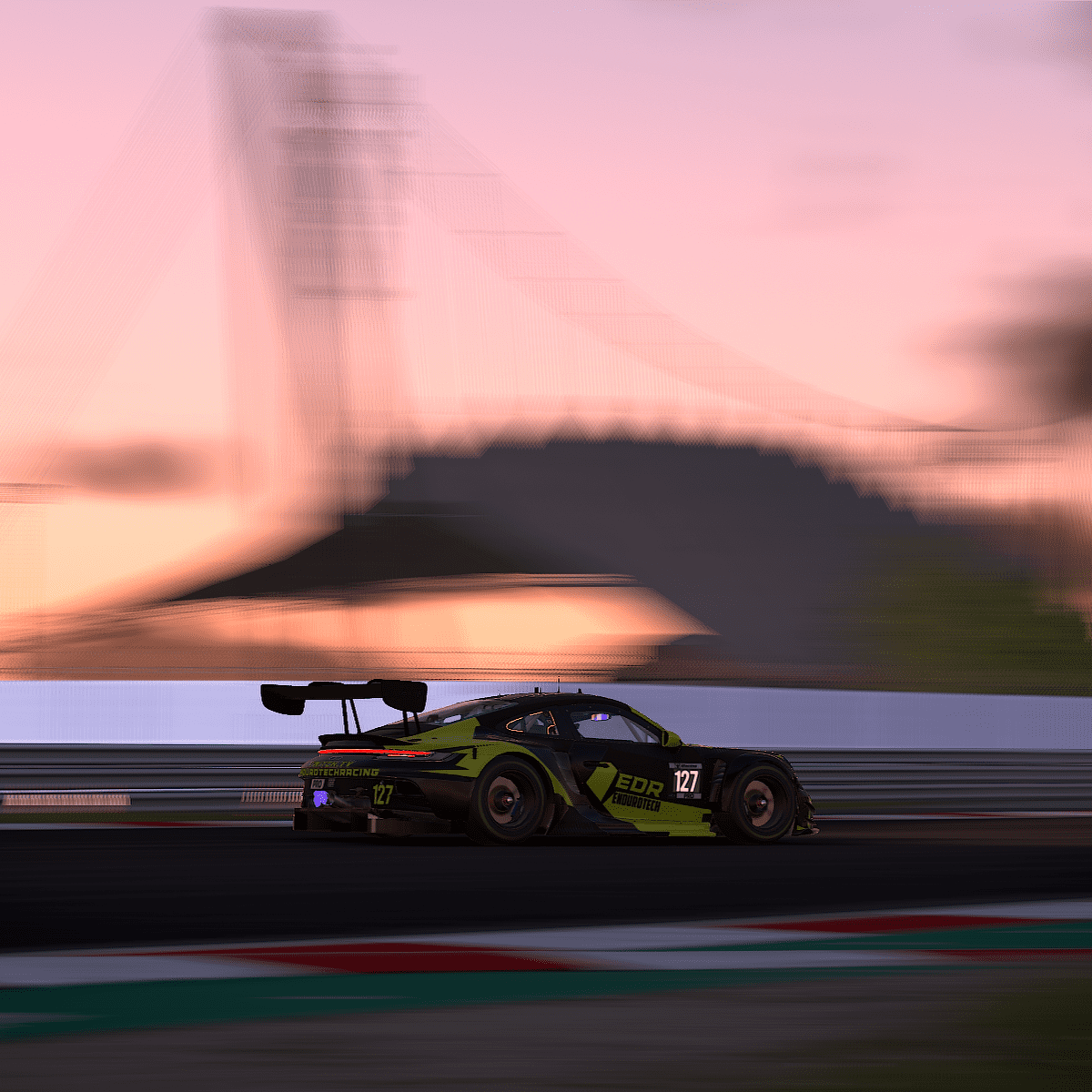
A knife-edge setup that’s fast for one qualifying lap will betray you ten hours into a race. A proper endurance sim racing car setup must prioritize stability, predictability, and tire longevity. We build our Porsche 911 GT3 R (992) to be forgiving. A comfortable car is one you can trust, which reduces mental load and minimizes unforced errors when fatigue sets in. Focus your adjustments on making the car compliant over curbs and stable on corner exit. A car that you don’t have to fight is a car you can drive quickly for hours. - Practice Effective Traffic Management
Multi-class racing is a core part of endurance, and managing it is an art. As iRacing’s own documentation on racecraft highlights, preparing for these interactions is essential. If you are in the slower class car, your job is to be predictable. Hold your line and use turn signals or voice chat to signal your intentions early. Don’t make sudden moves. If you are in the faster car, patience is your greatest asset. A low-risk overtake that costs you half a second is better than a high-risk move that ends your race. Plan your passes and execute them decisively on straights or corner exits. - Develop a Robust Pit Stop Strategy
Pit stops are not just for fuel and tires; they are strategic opportunities. A well-executed stop can gain you significant time, while a sloppy one can undo an entire stint’s worth of hard work. Your strategy should account for driver swaps, potential safety cars, and track position. Do you take tires now or stretch another stint? Do you short-fuel to gain track position? These decisions must be planned. Equally important is practicing your pit entry and exit at speed. Those few seconds saved by hitting your marks perfectly add up over a 24-hour race. - Train Your Physical and Mental Stamina
Sim racing is a sport, and it demands physical and mental endurance. We can all recall that feeling of exhaustion deep into a race where focus starts to fade. Combat this by ensuring your setup is ergonomic to prevent back and shoulder pain. Stay hydrated and have light, easily digestible snacks on hand. Practise the stint lengths your team plans to use, schedule breaks and arrange a handover if fatigue affects your concentration. - Master Fuel and Tire Conservation
Learning to manage your resources is a non-negotiable skill. For fuel saving, master the ‘lift and coast’ technique. By lifting off the throttle slightly earlier before the braking zone, you can save a surprising amount of fuel over a stint with minimal time loss. For tire management, it’s all about smooth inputs. Abrupt steering, throttle, and brake applications scrub the tires, generating excess heat and accelerating wear. Smoothness preserves the tires, keeping the car’s handling consistent and predictable deep into a run. - Utilize Your Team and Spotter Effectively
You are not alone in the car. Endurance racing is a team sport, and your spotter is your lifeline. The driver’s job is to focus on the next corner. The spotter’s job is to manage the bigger picture: calling out traffic, monitoring gaps, calculating fuel numbers, and advising on strategy. Before any race, establish clear and concise communication protocols. This synergy is how a global team like ours functions, with drivers, spotters, and engineers working as one unit. You can see the dedicated people who make this possible by learning more about our team structure. - Simulate Full Race Conditions in Practice
Practicing on an empty server with ideal conditions is a common mistake. It doesn’t prepare you for the chaos of a real race. Join busy official practice sessions to master driving in traffic. More importantly, run sessions that transition from day to night. You need to experience how changing track temperatures affect grip and how your braking markers change when visibility drops. There is no substitute for practicing in the exact conditions you will face on race day. - Learn to Adapt to a Dynamic Track
A racetrack is a living thing. Over 12 or 24 hours, it evolves. The racing line rubbers in, changing grip levels. Ambient and track temperatures rise and fall, affecting tire performance and car balance. You must learn to feel these changes and adapt your driving. The line that worked in hour one might not be the fastest in hour ten. Mental flexibility is what separates good drivers from great ones. Can you find new grip and adjust your braking points on the fly? - Conduct Thorough Post-Race Analysis
The race for improvement doesn’t end when the checkered flag waves. The most critical learning happens afterward. Review your telemetry data. Where were you losing time? Were your throttle and brake inputs as smooth as they could be? Watch the race replay to analyze strategic decisions and on-track mistakes. This data-driven approach is what turns experience into expertise. It’s how we identify our weaknesses and turn them into strengths for the next event, a process reflected in our team’s race reports and results.
| Day | Session Focus | Duration | Primary Goal |
|---|---|---|---|
| Monday | Setup & Telemetry Baseline | 60 Minutes | Establish a stable, comfortable setup and record baseline lap data. |
| Wednesday | Single Stint Practice | 90 Minutes | Run a full fuel stint focusing on consistency using the relative delta. |
| Friday | Multi-Class Race Simulation | 2 Hours | Practice traffic management and race pace in a busy official server. |
| Saturday | Qualifying & Race Start | 45 Minutes | Practice one-lap pace on fresh tires and navigating the opening laps. |
| Sunday | Data Review & Recovery | 60 Minutes | Analyze telemetry from the week’s sessions to identify areas for improvement. |
This table provides a structured approach to practice, ensuring all key aspects of endurance racing performance are addressed throughout the week. The goal is to build muscle memory, mental stamina, and strategic awareness systematically.
From Preparation to Podium
Success in endurance sim racing is never an accident. It is the direct result of meticulous preparation, unwavering consistency, and the seamless execution of a team strategy. Victories at events like the Bathurst 12 Hour or the 6 Hours of Watkins Glen are earned long before the green flag drops. They are earned in practice sessions, setup sheets, and strategy meetings.
These ten sim racing tips provide a framework for building your own success. However, true mastery is a continuous process of practice, data analysis, and a relentless passion for pushing the limits. Apply these strategies in your next iRacing event, and you will be a smarter, faster, and more formidable competitor. If you have the dedication and talent to compete at this level, we invite you to connect with our team and explore what we can achieve together.