State of iRacing broadcasting 2026
iRacing Broadcasting Has an Operator Problem, Not an Overlay Problem
See where iRacing broadcast workload builds up and how camera control, incident review, replay planning and crew roles can make a show easier to run.
Our position
In 2026, professional-looking graphics are expected. The harder and more valuable problem is production orchestration: cameras, incidents, replays, race control, commentators, remote crew, sponsor obligations and failure recovery working as one system.
Perspective, not neutral research
Published 19 July 2026 by the team building EDR Broadcast. This is our argument about the market, not an independent industry report. We name competing approaches because a healthy ecosystem makes every iRacing broadcast better.
Picture a normal league night. The person on the broadcast PC is changing cameras, watching gaps, reading Discord, loading a lower third, trying to work out why the yellow came out and listening to a commentator ask for the replay. A steward sends a message. OBS is still live. The best battle on the circuit is happening three corners away from the camera.
Nothing in that list is solved by adding another font option to the timing tower.
What failed on your last broadcast?
We missed the race-deciding contact
That is an awareness and replay workflow problem. The graphics may have been perfect while the show looked in the wrong place.
The camera stayed on the leader during a better midfield fight
That is a story-selection problem. Timing data must influence camera priorities without removing human control.
The commentator knew less than Twitch chat
That is an information-routing problem. The crew needs useful timing, incident and race-state context, not just the same programme picture as viewers.
The backup operator could not take over
That is an operational design problem. A production surface should expose current state, active controls and safe handover without tribal knowledge.
The stream looked busy but viewers were confused
That is an editorial graphics problem. Every overlay needs a specific job and a clear exit condition.
The overlay era solved a real problem
ATVO helped establish professional custom graphics in iRacing broadcasting. SDK Gaming built detailed timing, HUD and streamer workflows. JRT, RaceLab and community projects made live data accessible to more drivers and producers. Those products solved real needs, and they remain useful in 2026.
Good timing graphics are no longer rare. Browser rendering, NDI, live telemetry libraries and modern web design have lowered the barrier. A new product can show positions, gaps, flags and a track map without redefining the category.
That is progress. It also means a product cannot claim industry leadership merely because it has a polished leaderboard.
The modern operator is doing at least twelve jobs
Direct the cameras
Choose the car, camera group, shot length and moment to move.
Watch the whole field
Find battles and incidents outside the programme view.
Run replays
Locate, frame, cue, label and return live cleanly.
Operate graphics
Show the right layer, update state and avoid visual clutter.
Support commentary
Surface names, classes, gaps, pit context and story cues.
Follow race control
Handle cautions, penalties, restarts and official messages.
Protect the stream
Monitor OBS, encoder, audio, dropped frames and source failures.
Meet sponsor commitments
Trigger straps, bumpers, tickers and branded segments.
Coordinate remote crew
Grant access, respond to messages and keep the host in charge.
Manage handovers
Transfer control without losing current state or repeating coverage.
Create clips
Mark moments that deserve a replay, highlight or social cut.
Make editorial calls
Decide what matters now and what can wait until the field settles.
A large production can assign those jobs to specialists. Most iRacing leagues cannot. The industry opportunity is not pretending one volunteer is a television truck. It is giving that volunteer better leverage.
The new competitive layer is the control loop
A production tool becomes more valuable when its parts share state. Live timing identifies a closing gap. That gap becomes a camera candidate. The camera holds long enough for viewers to understand the fight. An incident elsewhere becomes a logged replay candidate. Race control can review it without stealing the live programme.
This loop matters more than the number of separate features. Ten disconnected apps may each be excellent, but the operator still carries the integration in their head.
| Signal | Production decision | Viewer result |
|---|---|---|
| Gap is closing rapidly | Raise battle priority and prepare the focused-driver context | The camera arrives before the pass, not after it |
| Possible contact off camera | Log the time and cars without abandoning live action | Replay appears in the next safe window |
| Caution or restart state | Change camera rhythm, graphics and story priorities | Viewers understand why the race slowed and what comes next |
| Same cars have dominated coverage | Apply anti-repetition unless the race story demands otherwise | More of the field and more league members appear on air |
Automation should assist judgement, not hide it
iRacing already includes native director modes. Third-party camera directors also exist. The question is not whether a computer can change cars. The question is whether the system makes understandable choices, exposes what it is doing and lets the producer override it instantly.
Bad automation cycles randomly, changes too often and treats a small gap as the whole story. Good automation understands race state, shot duration, repetition, class context and closing laps. It behaves predictably enough that a human can work with it.
The producer must remain the editor. A manual lock, a clear active target and an easy return from replay are not optional safety features.
Remote production needs roles, not one shared password
Distributed leagues are normal. Commentators, stewards and graphics helpers may be in different cities or countries. Remote access is valuable, but a URL that gives everybody every control is not a production system.
Good remote tools define who may change cameras, trigger graphics, send race-control messages or only observe timing. They confirm actions, show connection state and let the host revoke access. The browser is just the transport. Trust and scope are the design problem.
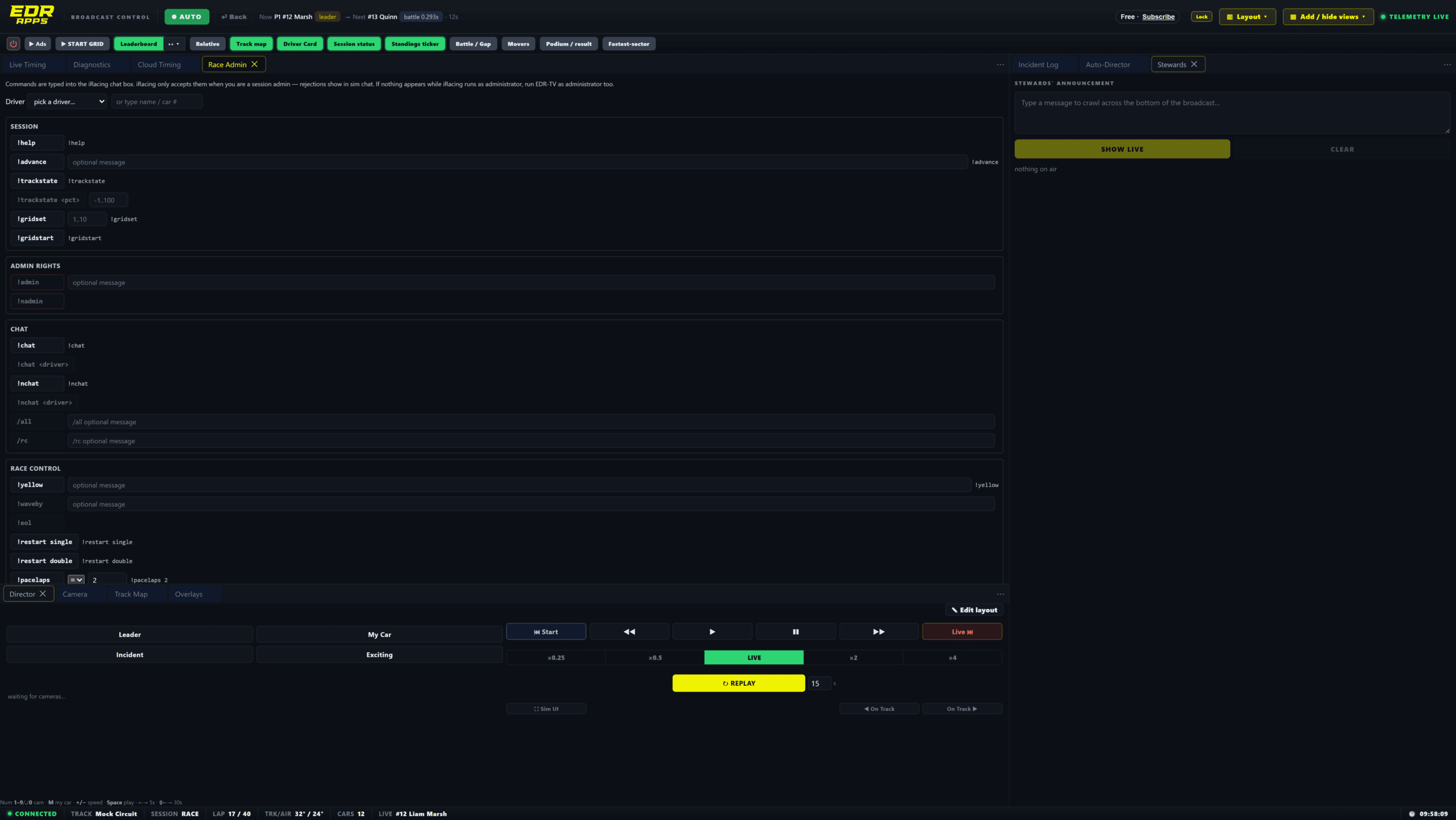
A control room is valuable when the information, decisions and outputs belong to the same production state.
What we want the iRacing broadcast market to compete on
Where EDR Broadcast fits
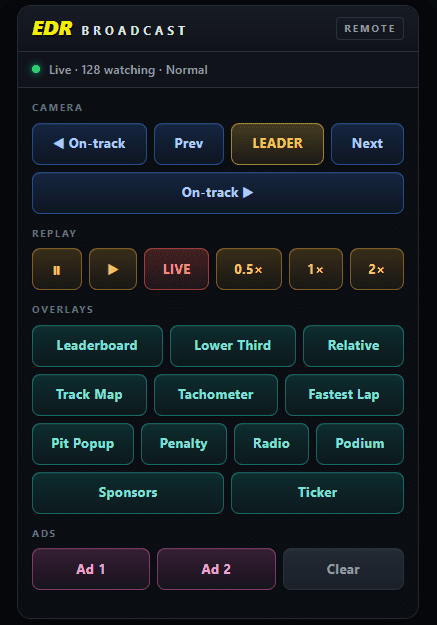
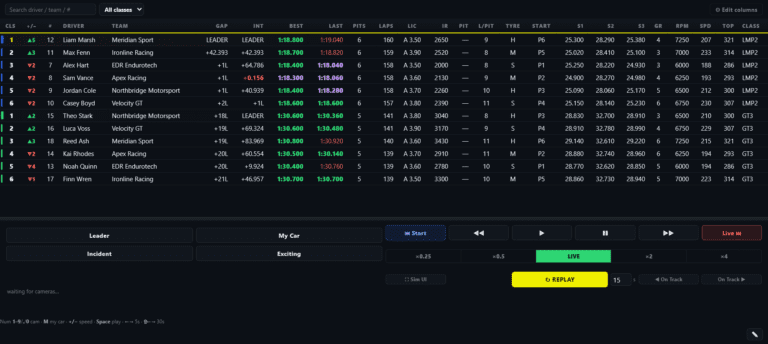
We built EDR Broadcast because our own endurance broadcasts exposed the operator problem. The app connects browser-source graphics to Auto-Director, manual cameras, incident detection, replay transport, race-control workflow and remote crew support.
We are not claiming to replace every specialist. ATVO has a stronger visual theme builder. SDK Gaming has a mature timing, HUD and remote commentator ecosystem. Open-source builders can offer unmatched local ownership. Those strengths make the market better and give us a higher standard to meet.
EDR is also in public beta. That means leagues should test it properly, read the known issues and keep a fallback scene for important events. Leadership is not pretending software never fails. It is being clear about how to operate safely when it does.
The test we think every vendor should survive
Give the production to a capable league volunteer who did not build the original scene.
Remove one expected crew member ten minutes before the race.
Run a multiclass field with an early caution, a missed off-camera incident and a late lead battle.
Ask the volunteer to show the incident replay without missing the live restart.
Hand control to a second operator mid-race.
Watch the final stream on a phone and ask a new viewer to explain the race state.
Count the window changes, missed moments and unclear handoffs. That is the product benchmark.
We want the disagreement
If you build ATVO themes, operate SDK Gaming, maintain an open-source overlay stack or produce broadcasts another way, tell us where this argument is wrong. The category improves when tools are compared on real production work rather than marketing screenshots.
Start with the current 2026 iRacing broadcast software comparison. If a fact is stale or a product is missing, contact us with the official source and we will review it.
Judge EDR on a full race, not a screenshot
Run the Free plan, start the 14-day Pro trial inside the app and test the cameras, incident log and replay loop in a practice broadcast. No card and no automatic subscription.
Download EDR Broadcast Challenge the Comparison