Remote iRacing broadcast workflow
How to Run an iRacing Broadcast with a Remote Crew
Organise a remote iRacing broadcast crew with clear camera, graphics and commentary roles, host control and rehearsed connection fallbacks.
Quick answer
Keep iRacing and OBS under one host, split remote work by role, use a low-delay programme return, give each person scoped controls, confirm every action and rehearse disconnection. Remote production is a permissions and feedback problem before it is a browser problem.
Reviewed 19 July 2026
This guide covers distributed league crews. EDR Broadcast is currently in public beta, so remote roles and limits should be checked on the current pricing and beta pages before a major event.
What job are you moving off the host PC?
Camera selection
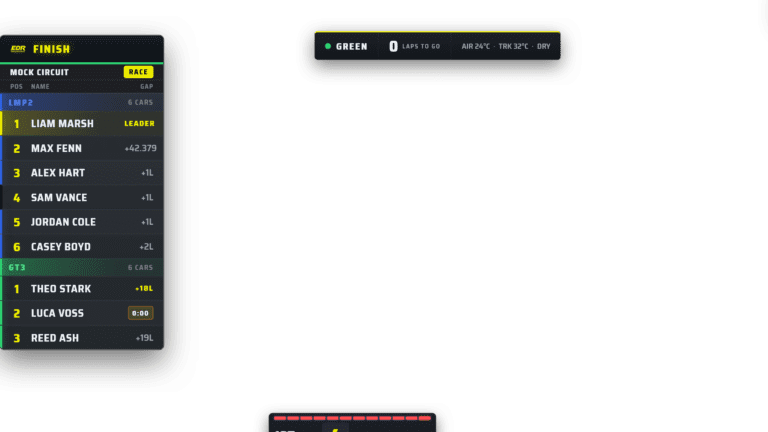
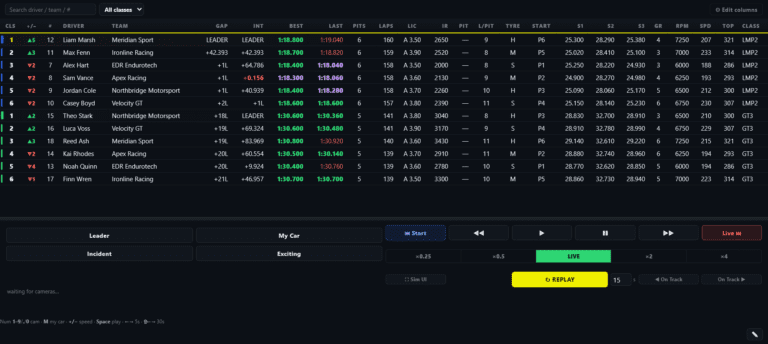
The remote operator needs current timing, the active target, camera controls, manual lock state and confirmation that the host accepted the change.
Graphics
Give show and hide controls for approved overlays, current on-air state and preview where possible. Do not also grant replay or race-control commands by default.
Commentary
Provide programme return, live timing, driver identity, incident cues and private talkback. Most commentators do not need production-control rights.
Incident review or stewarding
Use a read-only incident feed plus specifically authorised race-admin actions. Keep private review separate from on-air messages.
Public live timing
This is a viewer service, not an operator seat. It should be read-only, simple on mobile and isolated from the control channel.
Remote production has four separate paths
Programme video
The picture and audio viewers receive. Remote crew needs a return with known delay, but it does not always need full platform-quality bitrate.
Live data
Timing, flags, focused car, incidents and session state. This can update separately from the video and should expose stale or disconnected state.
Control commands
Camera, graphics, replay or race-admin actions sent back to the host. These need permissions, acknowledgement and rate limits.
Crew communication
Commentary, talkback, steward chat and emergency stop instructions. Keep public and private channels clearly separated.
Trying to force all four paths through one remote desktop session makes every failure harder to diagnose. A video delay is not the same as a rejected control. A lost talkback channel is not the same as stale timing.
The host must remain the authority
The host is connected to iRacing, owns the OBS programme and can see whether a command actually changed the local session. Remote operators should request actions through an authorised path.
A practical crew-role matrix
| Role | Needs to see | May control | Should not receive by default |
|---|---|---|---|
| Host producer | Everything, including connection and on-air state | All local production controls | Nothing required beyond role policy |
| Camera operator | Timing, active target, programme return | Camera target, group and approved replay navigation | Billing, account and unrelated race admin |
| Graphics operator | Current overlay and programme state | Approved graphics and prepared messages | iRacing admin commands |
| Commentator | Programme, timing, driver and incident context | Normally none, or limited prepared cues | Direct camera, replay and steward controls |
| Steward | Incident feed, timing and private review | Only explicitly assigned race-admin actions | On-air graphics unless the producer enables them |
| Viewer | Public timing and stream | Nothing | Every production and race-control action |
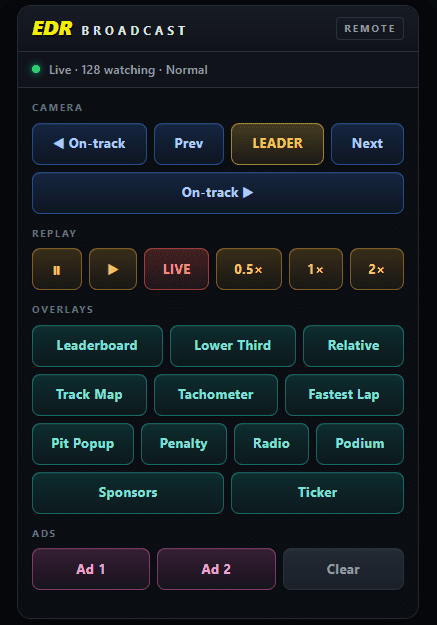
The remote surface should expose a role’s job and current state, not mirror the entire host desktop.
Remote desktop is a recovery tool, not the normal control surface
A remote desktop application can be useful when a trusted administrator must repair the host machine. It is a poor default for multiple race-night operators because it exposes the entire desktop, competes for mouse and keyboard, and makes individual permissions difficult.
If you keep remote desktop for emergencies, restrict who can use it, rehearse the connection, disable clipboard or file transfer where appropriate and never let it become the only way to operate the show.
Delay changes what each role can do
| Role | Delay sensitivity | Design response |
|---|---|---|
| Live camera operator | Very high | Use current data and a low-delay return; confirm host action quickly |
| Graphics operator | High for reactive graphics | Show explicit on-air state and avoid blind toggles |
| Commentator | High for picture matching | Know programme delay and align talkback |
| Incident reviewer | Moderate | Use timestamps and logged session time rather than wall-clock guesses |
| Public timing viewer | Moderate | Show data freshness and never claim zero delay |
How EDR Broadcast handles the model
EDR Broadcast keeps the Windows host connected to iRacing and OBS. Supported League workflows add remote browser control and public live timing, with the host retaining authority over the session.
The product is in public beta. Test role permissions, disconnection, invite rotation and the exact number of operators allowed by the current plan before race night. Do not rely on a marketing screenshot for a critical event workflow.
The remote-crew rehearsal
Create each operator separately and give only the role intended for race night.
Confirm every person can identify the host state, active camera or graphic and programme delay.
Run normal camera, graphics and incident tasks while the host watches acknowledgements.
Disconnect one remote operator during an action, then reconnect and confirm the current state is correct.
Have the host freeze remote commands and continue the local show.
Rotate or revoke an invite and confirm the old access no longer works.
Finish the session and check that public timing and remote control close cleanly.
Write down the fallback: who takes each job if the remote path fails at the green flag.
Frequently asked questions
Can someone control my iRacing broadcast from another country?
Yes, with a remote workflow that sends data and authorised commands to the host. Video return delay and connection quality still affect what roles are practical.
Do remote operators need iRacing installed?
It depends on the product and role. Browser-based controls may not. A synced remote spectator-client workflow does require compatible iRacing access and setup.
Should commentators receive camera controls?
Not by default. Give them programme return, timing and talkback first. Add a limited control only when the production plan requires it.
Is remote desktop safe for league production?
It can be secured for trusted emergency administration, but it exposes a broad surface and is not ideal as the normal multi-operator control model.
What happens if a remote operator disconnects?
The host should keep the local show running. The role should reconnect into current state rather than replaying old actions. Test this before the event.
Does EDR Free or Pro include remote crew?
Remote browser control and public live timing are League features on the current plan structure. Check the live pricing page because beta packaging may change.
Connect the distributed crew
Give commentators the right timing desk, keep viewers on the read-only live page, and rehearse the incident and replay handoff before assigning remote roles.
Split the work without surrendering the host
EDR Broadcast League adds remote browser operators and public live timing around the local iRacing and OBS production.
Compare League