iRacing commentary tools and workflow
What an iRacing Commentator Needs on Screen
Build a useful iRacing commentator screen with live timing, class positions, incident context and communication with the production crew.
Quick answer
An iRacing commentator needs the live programme, full-field and class timing, focused-car context, last and best laps, pit state, flags, incident cues, driver identity and a private production channel. The screen should answer the next question without competing with the commentary.
Reviewed 19 July 2026
This is a practical commentary desk guide for league and endurance broadcasts. It assumes the commentator and producer may be in different locations.
The producer has changed camera. What do you need next?
The camera moves to a car I was not discussing
Identify the driver, class position, gap ahead and why the car may matter. If the production cue is unclear, describe what is visible before guessing the story.
A replay starts
State that viewers are watching a replay, establish when and where it happened, then describe evidence rather than assigning blame before race control decides.
A class leader pits
Check whether rivals have stopped, identify the current driver and frame the order as provisional until the cycle settles.
The camera stays on a quiet leader
Use timing to find the next developing battle, then cue the producer privately instead of filling airtime with invented drama.
A remote steward sends a note
Separate official information from observation. Attribute a confirmed race-control message clearly and avoid presenting an internal review as a final decision.
The four-screen ideal, reduced to one useful desk
A commentator could use a programme monitor, full timing screen, notes, incident feed, Discord, driver roster and race-control channel. Most volunteer desks do not have seven monitors. The job is to combine information by priority.
1. Programme picture
The exact video viewers see, including overlays and replay labels. Commentary must match the output, not a different local camera.
2. Race timing
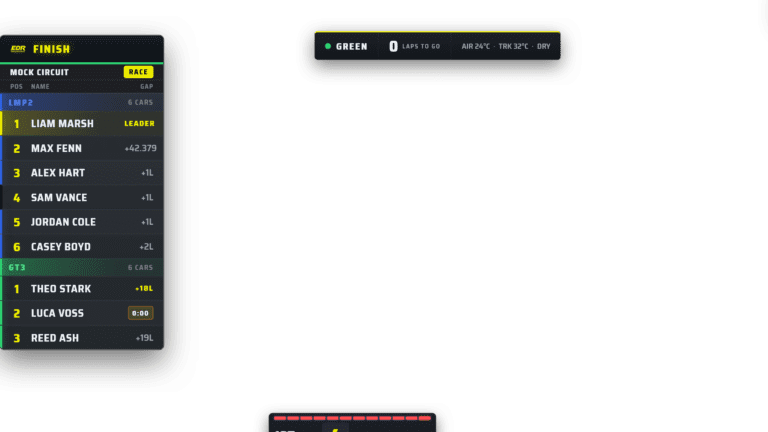
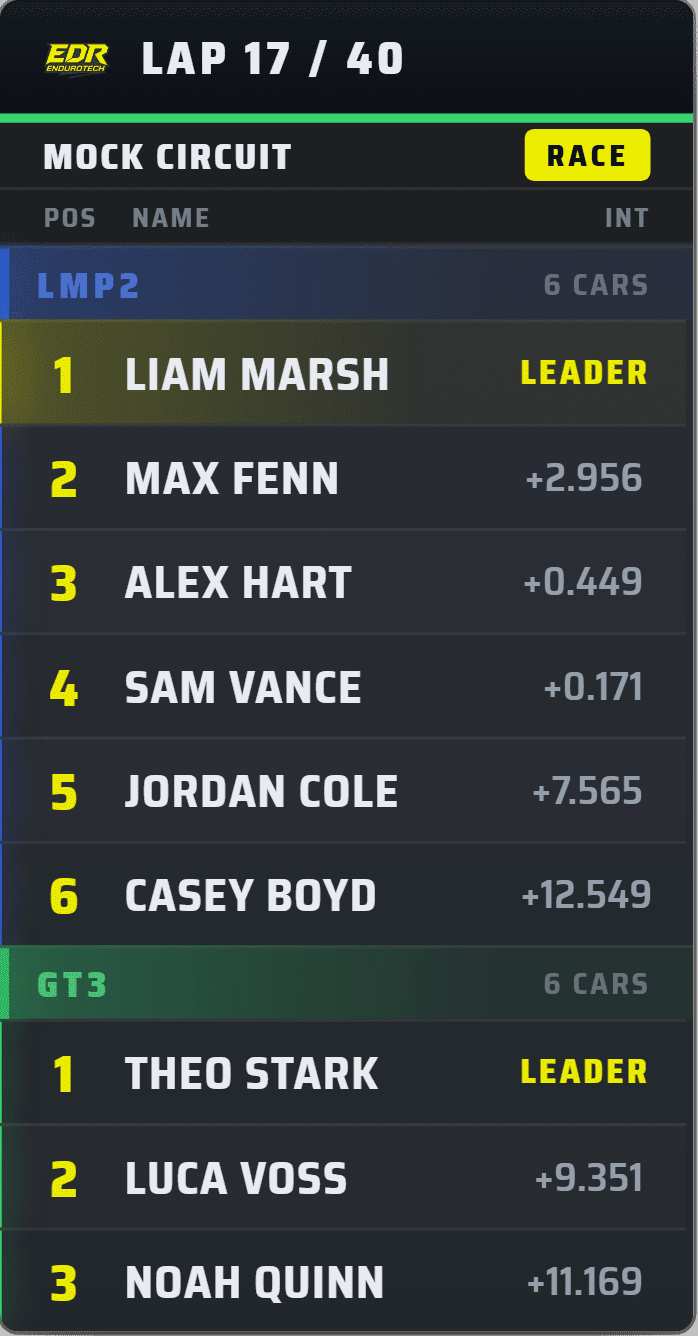
Overall and class order, gaps, pit state, laps, flags and current driver. This is the primary fact surface.
3. Story and incident feed
Movers, closing battles, lead changes, possible incidents and replay status. These are prompts to verify, not facts to read blindly.
4. Private production channel
Short cues from director, producer and race control. It should not be mixed with public chat or team chatter.
The timing fields that earn screen space
| Field | Question it answers | Trap |
|---|---|---|
| Class and overall position | What race is this car actually leading or fighting? | Calling overall P18 irrelevant when it is class P1 |
| Gap ahead and behind | Is a battle developing and which direction is it moving? | Reading one gap without trend or traffic context |
| Last and best lap | Is pace changing or was one lap exceptional? | Comparing laps set under different traffic or tyre states |
| Pit and stop state | Is this track position settled? | Calling a provisional cycle position a completed pass |
| Current driver | Who is in the car now? | Reading the entry name after a driver swap |
| Incident cue and timestamp | What may deserve review? | Treating detection as a final steward decision |
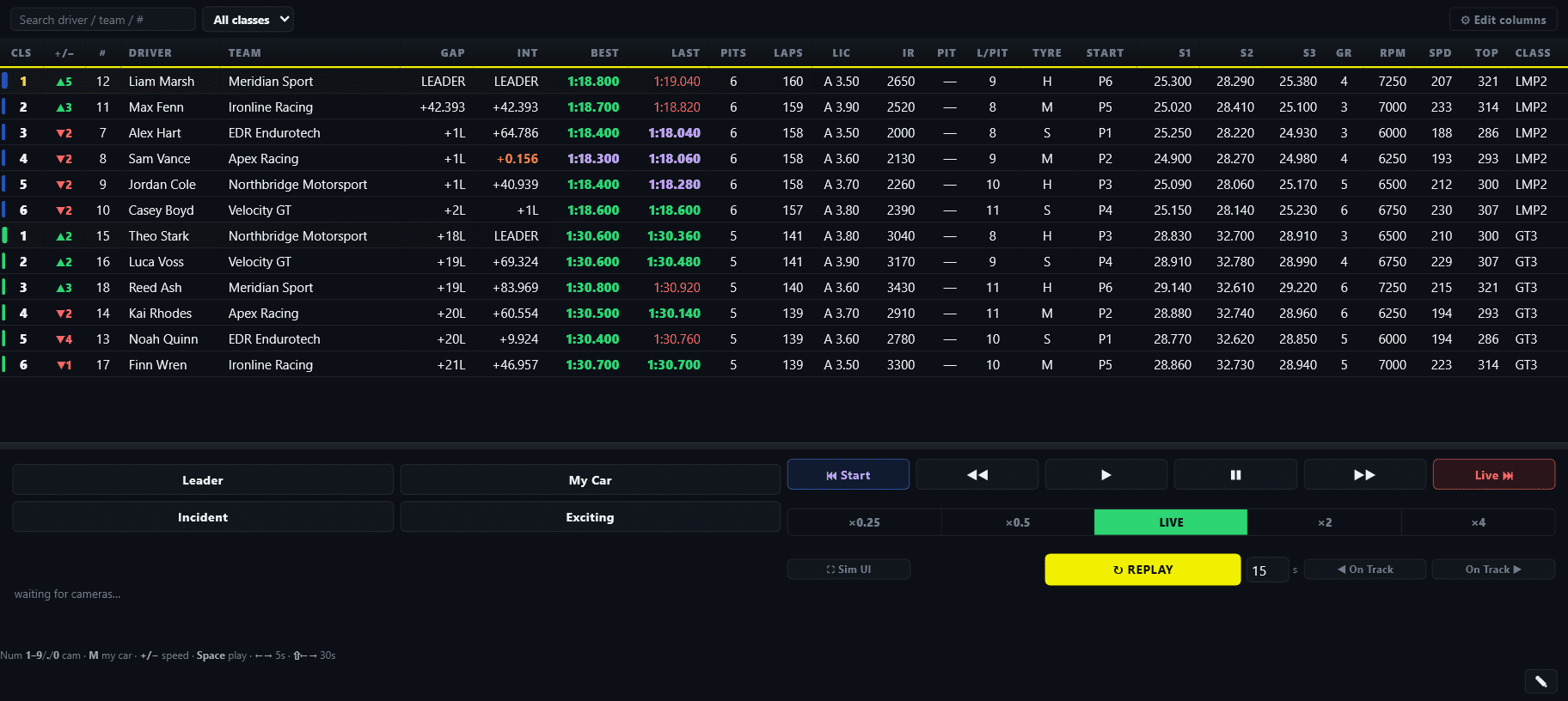
A commentary timing desk should reveal the race beyond the current camera without turning every signal into a claim.
Facts, inferences and opinions need different language
How remote commentary should work
A remote commentator needs a low-delay programme return, timing, private talkback and a clear clock reference. If their local iRacing client follows a different camera, they can describe a picture viewers never saw.
Some systems sync remote iRacing camera and overlay state. SDK Gaming documents a room workflow for remote commentators. EDR Broadcast League takes a browser-based crew approach for supported production roles and public timing. Compare the exact remote workflow, not simply whether a product uses the word “remote”.
| Channel | Purpose | Rule |
|---|---|---|
| Programme return | See the exact output and replay state | Know and rehearse the delay |
| Commentary audio | On-air voices | Producer can mute or isolate safely |
| Talkback | Short private cues | Never leak to programme |
| Race control | Confirmed official information | Read-only unless the role requires action |
Two commentators need different jobs
A pair works best when both people are not trying to deliver the same sentence. Divide responsibility without making the roles rigid.
Lead commentator
Carries the live picture, starts and ends segments, identifies immediate action, handles resets and leaves clean space for analysis.
Analyst or colour commentator
Explains technique, traffic, strategy and likely consequences, watches timing beyond the camera and prepares the next useful point.
Shared discipline
Either person can call a major moment, but both should yield quickly, avoid talking over race control and confirm names before repeating an error.
The pre-race commentary pack
A commentary rehearsal that reveals problems
Run a 20-minute recorded session with the real remote audio route and programme delay.
Force one replay, one incorrect incident cue and one race-control message.
Swap lead and analyst roles for five minutes.
Have the producer change to an unexpected midfield car with no verbal cue.
Watch the recording and mark every unsupported claim, repeated phrase and moment both commentators spoke.
Remove one information panel from the desk. If nothing gets worse, it was clutter.
Frequently asked questions
What live timing should an iRacing commentator use?
Use a view with overall and class order, gaps ahead and behind, pit state, last and best laps, flags, current driver and incident cues. The best product depends on your wider broadcast stack.
Does a commentator need their own iRacing account?
A commentator can work from programme video and web timing, but a synced local spectator client may provide more control or lower-delay views. Check the product workflow and iRacing account requirements.
How do commentators avoid calling the wrong driver after a swap?
Use timing that identifies the current driver, not only the registered team entry, and verify the change before repeating it.
Should commentators read Twitch chat during the race?
Chat can surface viewer questions or missed moments, but it is not an official source. One crew member should filter useful messages rather than both commentators watching chat.
Can incident detection tell the commentator who is at fault?
No. It can flag a likely event and identify cars or time. Fault requires review under the league’s sporting rules.
Can EDR support remote commentators?
EDR League supports remote production and public timing workflows. Confirm the exact crew role and control limits during a rehearsal.
Build the commentator’s data path
Start with role-specific live timing, prepare the incident and replay language, then use the multiclass guide for class battles and pit cycles.
Give commentary the race beyond the camera
EDR Broadcast connects timing, driver context, incident cues and remote production so the commentary team can explain the story instead of chasing windows.
Download EDR