iRacing camera direction
What Is an Auto-Director in iRacing Broadcasting?
Learn how automatic camera direction supports an iRacing broadcast, when to override it and how to coordinate cameras with incident review and replays.
Quick summary
An auto-director is software that chooses broadcast cameras for you during an iRacing race. It watches the whole field, cuts to battles and cars in trouble, adjusts its behaviour under caution, and tightens onto the decisive fights in the closing laps. With one running, a league broadcast can go on air with zero camera operators.
Every sim racing broadcaster hits the same wall: the graphics update themselves, the commentary flows, but someone still has to sit on the camera switcher for the whole race. An iRacing auto director exists to take that job off a human, without making the show look robotic.
Updated 19 July 2026
iRacing includes native Director Mode. This article explains what a broadcast-focused layer should add: battle scoring, race-state behaviour, shot pacing, anti-repetition and immediate manual override.
What should the director do here?
The leader is alone and P8 is closing rapidly on P7
Move to the battle before the pass develops, unless a finish, caution or championship event makes the leader more important.
A possible incident happens off camera
Log it without abandoning a live lead battle. Show the replay in the next safe window.
The producer selects a specific car
Respect the manual lock until the producer releases it. Automation should never fight the operator.
The problem with manual camera direction
Directing an iRacing broadcast by hand means scanning the relative gaps of 40 or 60 cars, judging which battle matters most, cutting to it, and doing that again every few seconds. In a one hour sprint it is intense. In a 6, 12 or 24 hour endurance race it is unsustainable: attention fades, the same two cars end up on screen for laps at a time, and the race-changing moment happens off camera.
Most leagues solve this with people. A camera operator, a producer, sometimes a spotter feeding them information. That works, until the crew is not available, the race runs overnight, or the league simply does not have three volunteers every single round.
How an auto-director decides what to show
A basic camera rotator just cycles through cars on a timer. An auto-director reads the race. The one in EDR Broadcast makes its cuts on a handful of principles:
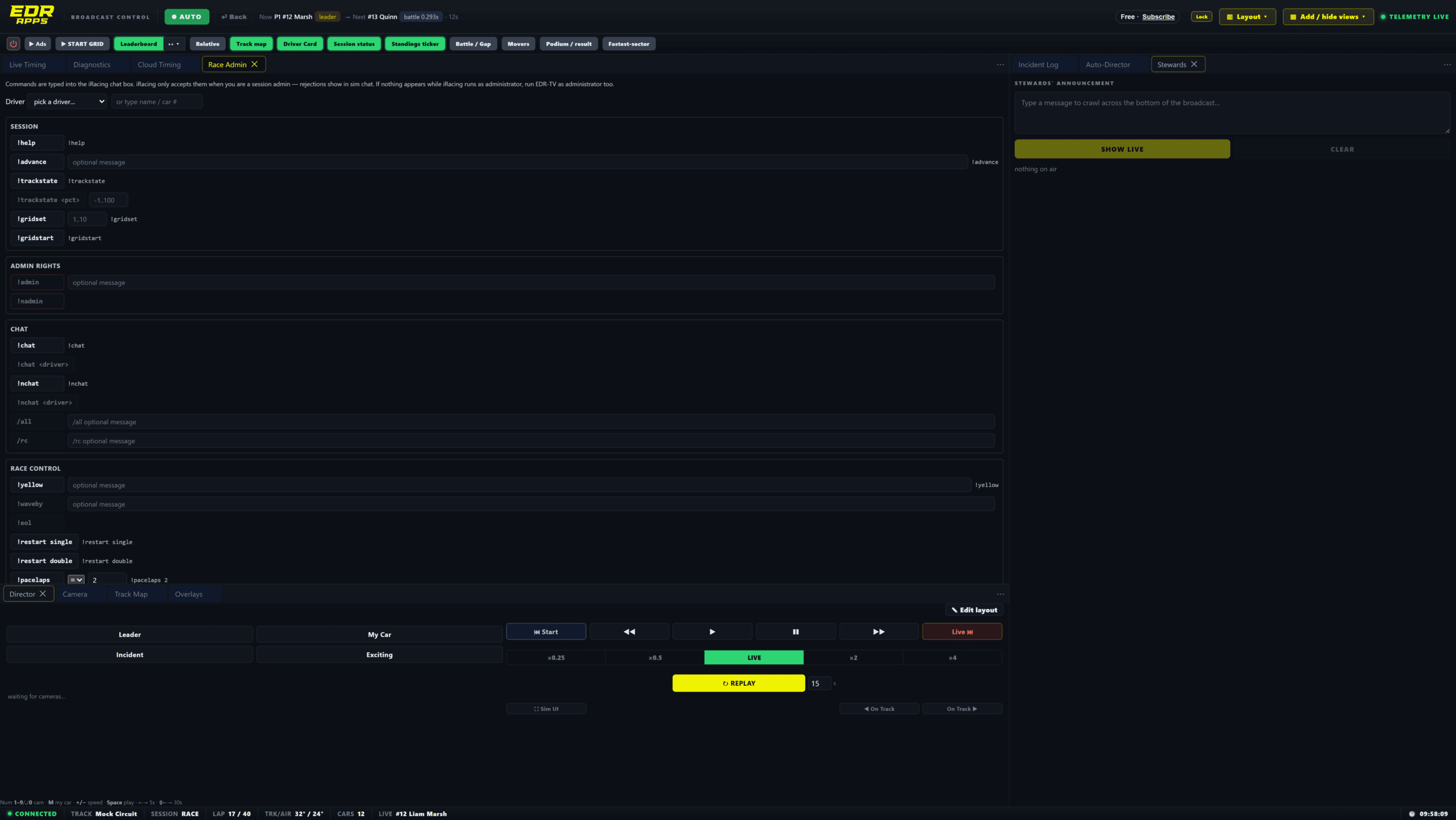
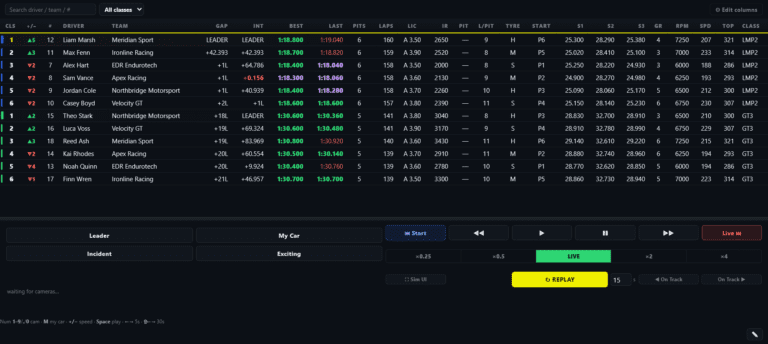
The operator control room: director cameras, live timing, replay transport and the incident log in one layout.
Manual operator vs auto-director
Neither approach wins every situation. Here is how they compare across a typical race night.
| Situation | Manual operator | Auto-Director |
|---|---|---|
| Lead battle mid-race | Strong, if the operator spots it forming | Strong, gap data means it sees the battle building before it arrives |
| Hour 14 of a 24 hour race | Fatigue sets in, coverage narrows | Identical performance at 3am and 3pm |
| Caution and restart | Good, with experience | Caution-aware cutting built in |
| Championship storyline | Best in class, humans know the narrative | Needs to be told: bias a driver, class or team and it follows |
| Cost per race night | One or more volunteers, every round | Included in EDR Broadcast Pro |
When you should still take the cameras yourself
An auto-director removes the routine cutting. It does not know that the driver in P8 announced their retirement this week, or that your sponsor wants a shot of their liveried car on the pit straight. Those are human calls, and the workflow is built for them: take a camera whenever you want the shot, then hand control back with the master switch.
The best shows we have run treat it like cruise control. The software handles the constant, repetitive decisions and the producer steps in for the moments that need judgement. If you are still setting up the rest of your show, start with our guide on how to broadcast an iRacing race with OBS.
Director’s note
A good director, human or software, holds a shot longer than you expect. Constant cutting looks busy. Patience reads as professional.
Setting up the Auto-Director in EDR Broadcast
Auto-Director is a Pro feature and is included in the 14-day Pro trial. Setup is short: pick any drivers, classes or teams you want the coverage to favour, tune the cameras and dwell time for each situation if the defaults do not suit your series, then arm it before the green flag. On the League plan your crew can even edit the director settings remotely from a browser mid-race.
Pair it with incident detection and the replay transport and the whole production loop closes: the director covers the field, the incident log tells you what it found, and the replay jumps straight to the moment. We cover that side in how to find and replay incidents in an iRacing broadcast.
EDR Broadcast resources
See the Auto-Director section on the EDR Broadcast page, check EDR Broadcast pricing, or watch a full race it directed on Twitch: cameras, overlays and incidents with no operator touching the switcher.
Related Endurotech Racing reading
Frequently Asked Questions
What does an auto-director do in an iRacing broadcast?
It selects broadcast cameras automatically. It watches the whole field, cuts to battles, incidents and restarts, and tightens onto the key fights in the closing laps, so the show can run without a camera operator.
Is the EDR Broadcast Auto-Director free?
Auto-Director is a Pro feature, and it is included in the 14-day Pro trial you can start inside the app after downloading EDR Broadcast.
Can I override the auto-director mid-race?
Yes. You can take a camera yourself whenever you want the shot, and a single arm and disarm switch hands control to the director or takes it back instantly.
Does it work under cautions and restarts?
Yes. The director reads the race state and changes how it cuts under yellow flags, on pace laps and at restarts.
Can it focus on a specific driver, class or team?
Yes. You can favour or lock onto a driver, class or team, and tune the cameras and dwell time the director uses in each situation.
Does the auto-director need an internet connection?
EDR’s local tools depend on the iRacing data available on the PC. An internet outage can interrupt live session data, streaming and remote control, so do not assume the timing or camera targets remain current. Use a standby scene and check the session after reconnecting.
Let the director run your next race
Try the Auto-Director, incident detection and the full 30+ overlay package free for 14 days, then keep whatever tier fits your league.
Start the Pro Trial Watch a Real Broadcast